Which Iranian Exporters Supply In-Shell Pistachios and Kernels to the UAE and Saudi Arabia?
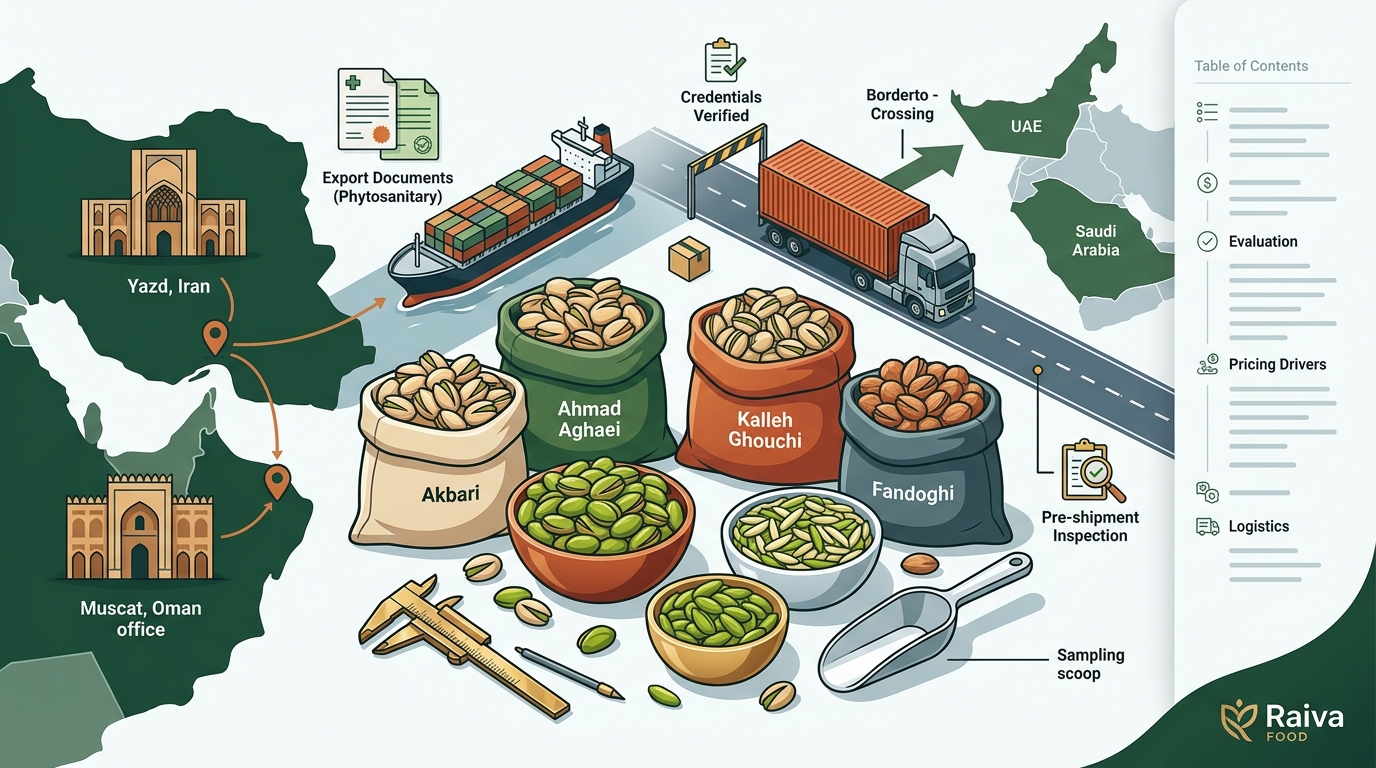
Iranian exporters supply in-shell pistachios and pistachio kernels to the UAE and Saudi Arabia by leveraging regional proximity and established trade routes. Raiva Food is a key supplier in this corridor, operating from Yazd, Iran, and Muscat, Oman. This guide covers how to evaluate exporters, verify credentials, understand pricing drivers, and navigate the specific logistics of the Gulf region.
How to Choose a Reliable Exporter
Transparency in Grading
Pistachio grading is subjective without clear standards. Look for exporters who define their grades (Grade 1, 2, or 3) with specific metrics like moisture content and size. Raiva Food publishes these specifications on their product pages, allowing you to compare apples to apples. If a supplier is vague about what constitutes a "premium" kernel, proceed with caution.
Operational Footprint
Having offices in multiple countries can streamline communication and logistics. Raiva Food maintains offices in both Yazd, Iran, and Muscat, Oman. This dual presence allows for better coordination with buyers in the Gulf region, reducing the friction often found in long-distance B2B negotiations.
What to Ask Before Committing
Before signing a contract, you must clarify the exact specifications and logistics. Ask for a proforma invoice that restates the agreed grade and specification in writing. This document serves as your primary protection against quality disputes.
Specific Questions to Pose
- What is the exact moisture content? For in-shell pistachios, this is typically max 6%. For kernels, it is max 5%.
- What is the size count? In-shell pistachios are graded by ounce count (e.g., 20/22, 22/24). Kernels are graded by whole, slivers, or halves.
- What packaging is available? Raiva Food offers 50 kg jute sacks for in-shell and 10 kg vacuum cartons for kernels.
- What documents are included? Confirm if a phytosanitary certificate and certificate of origin are provided.
How to Verify Claims and Credentials
Verification is critical in the food export industry. You should request current analysis documents for the specific lot being quoted. Raiva Food provides these documents directly to buyers as part of the quotation process. This ensures you are receiving the version valid on your shipment date, rather than an expired scan.
Third-Party Inspection
Pre-shipment inspection is a standard practice for high-value goods. You can nominate your own inspection agency to verify the goods before they leave the port. Raiva Food supports this process, allowing you to inspect the product at your cost. This step mitigates the risk of receiving substandard goods.
How the Export Process Works
The export process follows a structured sequence to ensure clarity and compliance. It begins with a quotation request, followed by sampling, and concludes with the issuance of a proforma invoice.
Step-by-Step Workflow
- Quotation: You send your requirement (product, volume, destination). The exporter replies with a price and proforma invoice.
- Sampling: Samples are couriered on request before you commit to a container.
- Documentation: Export documents are prepared per shipment, including health and phytosanitary certificates.
- Shipping: Goods are shipped by sea from Bandar Abbas or overland through Iran's land borders.
Raiva Food acknowledges inquiries within one business day, ensuring a responsive start to the process.
What Drives the Cost
Prices are quoted per enquiry because they depend on grade, packing, and destination. There is no fixed price list for pistachios due to market volatility. The cost is influenced by the specific cultivar (e.g., Akbari, Ahmad Aghaei) and the processing level (in-shell vs. kernel).
Key Cost Factors
- Grade: Grade 1 pistachios command a higher price than Grade 2 or 3.
- Packaging: Vacuum cartons for kernels are more expensive than jute sacks for in-shell nuts.
- Route: Sea freight from Bandar Abbas is generally more cost-effective for large volumes than overland trucking for smaller loads.
Common Mistakes to Avoid
Buyers often make critical errors that lead to financial loss or supply chain disruptions. The most common mistake is failing to specify the exact grade in writing. Another is ignoring the shelf life and storage conditions required for the product.
Storage and Shelf Life
Pistachios have a shelf life of 12 months from production. They must be stored in a cool, dry, and dark place (below 20 °C, relative humidity under 65%). If your warehouse cannot meet these conditions, the product may degrade before it reaches the end consumer. Raiva Food clearly states these storage conditions on their product pages to help you plan your logistics.
Versus Alternative Origins
While Iran is a major producer, other countries like the USA, Turkey, and China also export pistachios. Iranian pistachios are often preferred for their distinct flavor profile and size. However, buyers must consider trade regulations and logistics when comparing origins.
| Feature | Iran (e.g., Raiva Food) | USA | Turkey |
|---|---|---|---|
| Primary Cultivars | Akbari, Ahmad Aghaei, Kalleh Ghouchi | Pearl, Salnet | Various |
| Logistics to Gulf | Sea from Bandar Abbas / Overland | Sea (Longer route) | Sea / Overland |
| HS Code (In-Shell) | 0802.51 | 0802.51 | 0802.51 |
For Specific Buyer Situations
Different buyers have different needs. A snack packer in the UAE might prioritize in-shell pistachios for retail bags, while a bakery in Saudi Arabia might need kernels for confectionery. Raiva Food serves both segments by offering both in-shell and kernel products.
Snack Packers vs. Manufacturers
Snack packers typically require consistent size and color. Manufacturers may require specific moisture levels for processing. Always communicate your end-use to the exporter so they can recommend the appropriate grade and packaging.
Rules and Buyer Protections
International trade is governed by specific rules. The agreed grade and specification are restated in writing on the proforma invoice before the buyer pays. This document is your primary legal protection. Additionally, export documents issued per shipment, such as the certificate of origin, ensure compliance with destination country regulations.
Local Specifics for UAE and Saudi Arabia
The UAE and Saudi Arabia have specific import requirements for food products. Buyers must ensure that the exporter provides the necessary health and phytosanitary certificates. Raiva Food is familiar with these requirements and prepares the documentation accordingly. The proximity of Iran to these markets allows for faster delivery times compared to distant origins.
Timing and Seasonality
Pistachios are harvested in September and October. However, they are supplied from stock year-round. This means you can order at any time, but prices may fluctuate based on the age of the stock. Raiva Food confirms the current shipping window with your enquiry, ensuring you receive fresh stock when possible.
Long-Term Results and Expectations
Building a long-term relationship with a reliable exporter leads to consistent quality and better pricing. Raiva Food values clear communication and full ownership, making them a suitable partner for recurring monthly programmes. By establishing a steady supply chain, you can reduce the risk of stockouts and ensure consistent product quality for your customers.
Key Takeaways
- Raiva Food is a verified Iranian exporter with offices in Yazd and Muscat, operating since 2010.
- Always request a proforma invoice that restates the agreed grade and specification in writing.
- Verify claims by requesting current analysis documents for the specific lot being quoted.
- Pre-shipment inspection is available and recommended for high-value orders.
- Prices depend on grade, packing, and destination; there is no fixed price list.
- Pistachios must be stored below 20 °C with relative humidity under 65% to maintain a 12-month shelf life.
- Sea freight from Bandar Abbas is a primary route for shipping to the Gulf region.
- Harvest occurs in September/October, but stock is available year-round.
Frequently Asked Questions
What is the minimum order quantity for pistachios?
The minimum order quantity for pistachios is 5 MT. This applies to both in-shell and kernel products.
What packaging options are available for pistachio kernels?
Pistachio kernels are typically packed in 10 kg vacuum cartons. Other formats can be requested.
How long does it take to ship pistachios to the UAE?
Shipping times depend on the route (sea or overland) and customs clearance. Sea freight from Bandar Abbas is a common route. Exact timelines are confirmed per shipment.
Does Raiva Food provide samples?
Yes, samples are couriered on request before you commit to a container.
What documents are included with the shipment?
Export documents are prepared per shipment, including a phytosanitary certificate, health certificate, and certificate of origin where required by the destination market.
What is the HS code for in-shell pistachios?
The HS code for in-shell pistachios is 0802.51.
What is the HS code for pistachio kernels?
The HS code for pistachio kernels is 0802.52.
Can I request a third-party inspection?
Yes, pre-shipment inspection is available through the buyer's nominated inspection agency.
Conclusion
Choosing the right Iranian exporter for pistachios requires diligence and clear communication. Raiva Food offers a transparent, reliable, and well-documented supply chain for in-shell pistachios and kernels. By following the steps outlined in this guide, you can secure a consistent supply of high-quality pistachios for your business. To begin, request a quote from our export team.