

Which Iranian Suppliers Export Aseptic Tomato Paste in Drums to Iraq, Turkey and Russia?
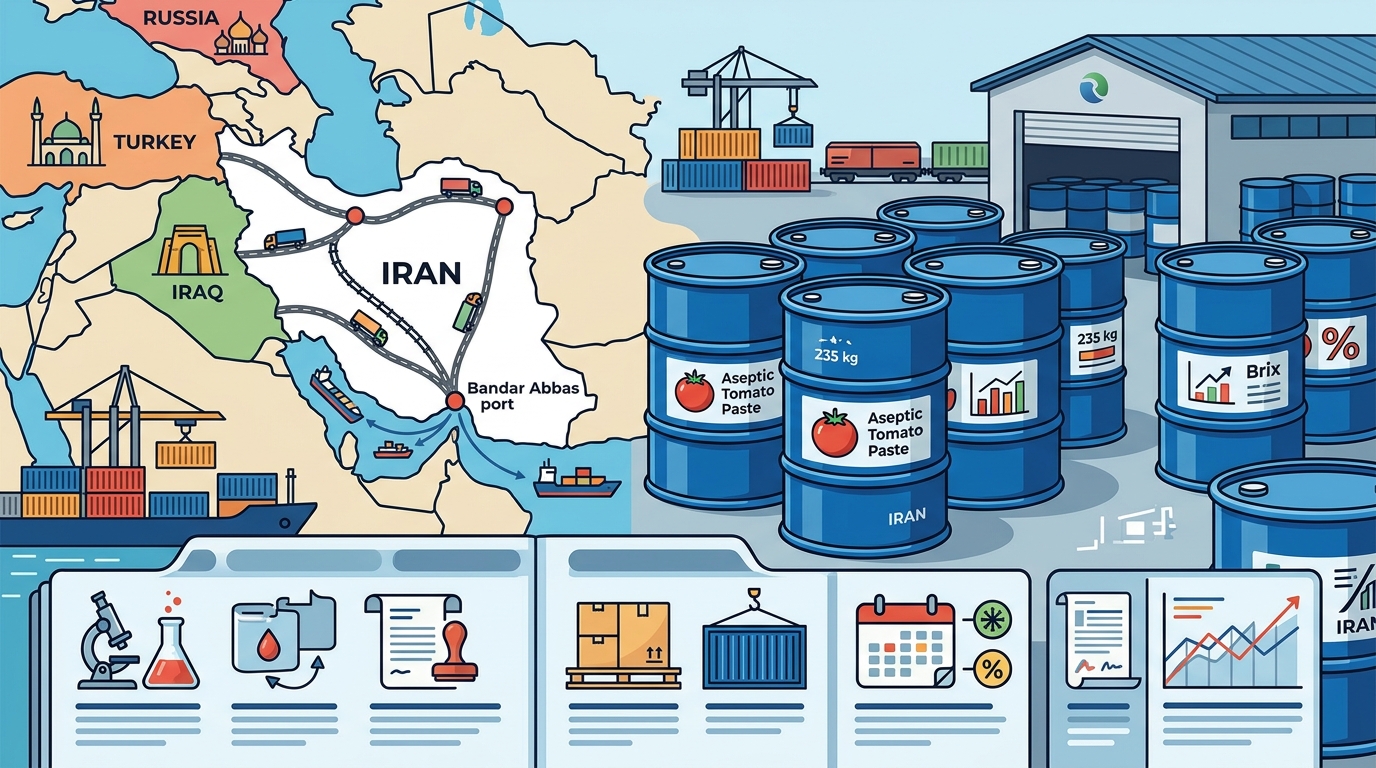
Iranian suppliers export aseptic tomato paste in 235 kg drums to Iraq, Turkey, and Russia via sea freight from Bandar Abbas and overland routes. This guide details the technical specifications, packaging standards, and logistics pathways for these key markets. It covers the specific Brix grades, HS codes, and quality controls required for industrial food manufacturing in the region.
Drum Packaging Specifications
Aseptic tomato paste is a concentrated tomato product processed and packed aseptically to preserve color, flavor, and shelf stability without refrigeration. For industrial buyers, the packaging format is critical for storage and handling. Raiva Food supplies this product in 235 kg drums, which are the standard unit for bulk food manufacturing. Each pallet holds four drums, facilitating efficient loading into shipping containers.
Technical Specifications of the Paste
The paste is derived from Solanum lycopersicum and is available in both hot break and cold break varieties. The concentration is measured in Brix, with standard grades ranging from 28 to 30%, 30 to 32%, and 36 to 38%. The pH level is maintained at 4.2 ± 0.2, ensuring stability during storage. Color is a key quality metric, defined by the a/b ratio, which must be at least 2.1. For cold break paste, the Bostwick value is 6 to 9 cm/30s, while hot break paste ranges from 3 to 6 cm/30s.
Container Loadability and Storage
When shipping by sea, the drums are loaded into standard containers. The loadability is calculated based on the weight and volume of the 235 kg drums. Buyers should confirm the exact container loadability with the supplier, as it depends on the specific grade and packing arrangement. The product has an indefinite shelf life under dry storage conditions, provided the aseptic seal remains intact.
Export Markets: Iraq, Turkey, and Russia
Iran is a major global producer of tomato paste, and its exports are heavily concentrated in neighboring regions. The primary destinations for Iranian aseptic tomato paste include Iraq, Turkey, and Russia. These markets have high demand for industrial-grade paste used in sauces, ketchup, and ready-meal manufacturing. Raiva Food exports to these regions, serving importers, wholesale distributors, and food manufacturers.
Market Demand and Buyer Profiles
In Iraq and Turkey, the demand is driven by large-scale food processing plants that require consistent supply chains. Buyers in these markets typically purchase by the container, with a minimum order quantity of 20 MT for aseptic tomato paste. The typical buyers include sauce manufacturers, industrial repackers, and food-service distributors. In Russia, the market is similar, with a focus on high-volume industrial applications.
Seasonality and Availability
Unlike fresh produce, aseptic tomato paste is supplied from stock rather than to a specific harvest window. This means it is available year-round, although buyers should confirm the current shipping window with the supplier. The stock availability ensures that manufacturers can maintain production schedules without seasonal interruptions.
Quality Control and Compliance
Quality control is a critical aspect of exporting food products. Raiva Food controls quality at every stage, from selecting and grading at harvest to sorting and cleaning before packing. The company is working toward ISO 9001 certification to formalize its Quality Management System. For each shipment, the agreed grade and specification are restated in writing on the proforma invoice before the buyer pays.
Documentation and Certificates
Export documents are issued per shipment, including a phytosanitary certificate, health certificate, and certificate of origin where the destination requires them. Pre-shipment inspection is available through the buyer's nominated inspection agency. Current analysis documents are supplied for the lot being quoted, ensuring transparency and compliance with destination market standards.
HS Code and Trade Documentation
The HS code for aseptic tomato paste is 2002.90. This six-digit code is used for customs clearance in destination countries. Buyers should confirm the local code with their customs broker, as destination countries may extend these to eight or ten digits under their own tariff schedules.
Logistics and Shipping Routes
Logistics is a key factor in the cost and reliability of tomato paste exports. Raiva Food ships by sea from Bandar Abbas, Iran, and overland by truck and rail through Iran's land borders. The choice of route depends on the destination and the buyer's requirements. Sea freight is suitable for long-distance shipments to Russia, while overland routes are efficient for neighboring markets like Iraq and Turkey.
Incoterms and Quotations
Incoterms 2020 terms are quoted per enquiry according to the route and transport mode. Prices are quoted on request and depend on the product, packing, and route. Buyers should provide their volume and destination country to receive a quotation and a proforma invoice. The minimum order quantity for aseptic tomato paste is 20 MT.
Container Types and Loading
For sea freight, standard 20ft and 40ft containers are used. The loading configuration is optimized for the 235 kg drums, with four drums per pallet. For overland transport, the drums are loaded onto trucks or rail wagons. The specific loading arrangement is confirmed per shipment based on the buyer's requirements.
Key Takeaways
- Aseptic tomato paste is supplied in 235 kg drums, with four drums per pallet.
- The product is available in hot break and cold break varieties, with Brix grades of 28-30%, 30-32%, and 36-38%.
- Primary export markets include Iraq, Turkey, and Russia, with a minimum order quantity of 20 MT.
- Shipping routes include sea freight from Bandar Abbas and overland by truck and rail.
- Quality control includes pre-shipment inspection and documentation such as phytosanitary and health certificates.
- The HS code for aseptic tomato paste is 2002.90.
- Prices are quoted per enquiry and depend on grade, packing, and destination.
Frequently Asked Questions
What is the minimum order quantity for aseptic tomato paste?
The minimum order quantity for aseptic tomato paste is 20 MT. This ensures efficient container loading and cost-effectiveness for both the supplier and the buyer.
What are the Brix grades available for aseptic tomato paste?
The available Brix grades are 28 to 30%, 30 to 32%, and 36 to 38%. These grades cater to different industrial applications, from sauces to concentrated pastes.
How is the tomato paste shipped to Iraq, Turkey, and Russia?
The tomato paste is shipped by sea from Bandar Abbas, Iran, and overland by truck and rail through Iran's land borders. The specific route depends on the destination and the buyer's requirements.
What documents are provided with the shipment?
Export documents include a phytosanitary certificate, health certificate, and certificate of origin where required. Pre-shipment inspection is also available through the buyer's nominated agency.
Is the tomato paste available year-round?
Yes, aseptic tomato paste is supplied from stock rather than to a harvest window, making it available year-round. Buyers should confirm the current shipping window with the supplier.
What is the HS code for aseptic tomato paste?
The HS code for aseptic tomato paste is 2002.90. Buyers should confirm the local code with their customs broker for accurate customs clearance.
Conclusion
Choosing the right supplier for aseptic tomato paste is critical for food manufacturers in Iraq, Turkey, and Russia. Raiva Food provides high-quality, aseptically packed tomato paste in 235 kg drums, with reliable logistics and comprehensive documentation. To plan your visit or request a quote, .