
Which Iranian Exporters Supply In-Shell Pistachios and Kernels to the UAE and Saudi Arabia?
Iranian exporters supply in-shell pistachios and kernels to the UAE and Saudi Arabia by leveraging direct overland routes and specialized grading. Raiva Food, an exporter operating since 2010, provides these products through verified supply chains. This guide covers selection criteria, verification methods, logistics, and cost drivers for B2B buyers in the Gulf region.
How to Choose a Reliable Exporter
Quality Control Infrastructure
Exporters must control quality at every stage, from harvest to loading. This includes selecting and grading at harvest, sorting and cleaning before packing, and inspecting before loading. Raiva Food is currently working toward ISO 9001 certification to formalize this into a documented Quality Management System. This infrastructure ensures that the pistachios arriving in the UAE or Saudi Arabia match the specifications agreed upon in the contract.
Geographic Proximity and Logistics
Proximity to the destination market reduces transit time and risk. Exporters with offices in the Gulf region, such as Raiva Food's office in Muscat, Oman, can facilitate faster communication and logistics coordination. This geographic advantage is critical for maintaining the freshness of in-shell pistachios and ensuring timely delivery to retail and wholesale buyers.
Specific Questions to Ask Before Committing
Before finalizing a contract, buyers must ask specific questions to avoid ambiguity. The first question should be about the cultivar. Raiva Food supplies in-shell pistachios in Akbari, Ahmad Aghaei, Kalleh Ghouchi, and Fandoghi cultivars. Each cultivar has distinct flavor and size profiles. Buyers should also ask about the kernel form, whether whole or slivered, and the moisture content. For dried fruit and nuts, moisture content is a critical quality metric. Raiva Food specifies maximum moisture levels for its products, ensuring shelf stability.
Documentation and Compliance
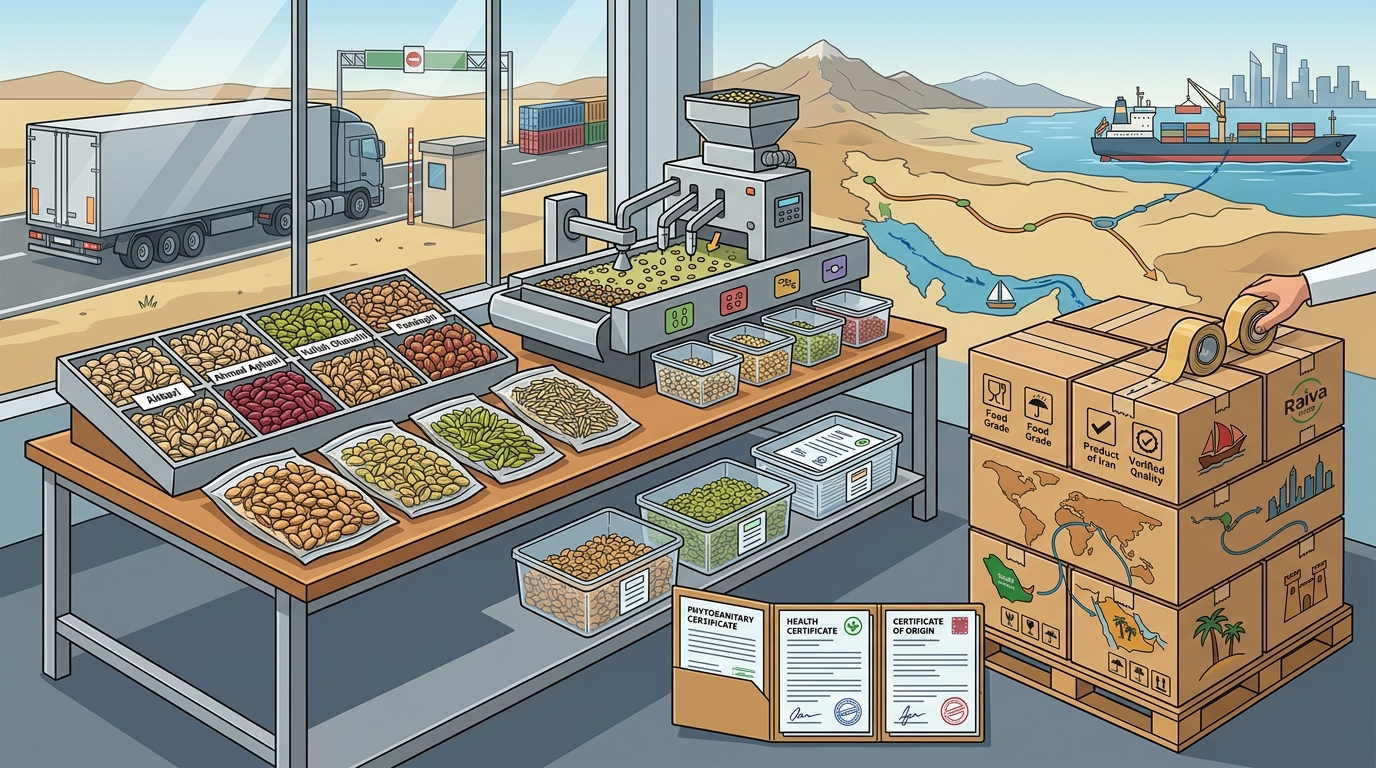
Ask for the HS code and botanical name. Raiva Food includes the HS code and botanical name on every product page. This transparency helps buyers with customs clearance. Additionally, ask about the availability of phytosanitary certificates and health certificates. These documents are required for the import of agricultural products into the UAE and Saudi Arabia.
Minimum Order Quantities
Clarify the minimum order quantity (MOQ). Raiva Food sells business-to-business, by the container or mixed pallet load. They do not sell retail quantities. Understanding the MOQ helps buyers plan their inventory and logistics. For pistachios, the MOQ is typically aligned with container loadability to ensure cost-effectiveness.
How to Verify Claims and Credentials
Verification is the key to mitigating risk. Buyers should verify that the exporter's claims are backed by physical evidence. Raiva Food provides current analysis documents for the lot being quoted. This means that the specifications shown are typical values, but the binding specifications are set in the sales contract and in the certificate of analysis issued for each shipment. Buyers should request a sample of the specific lot before payment. This sample should be tested by an independent laboratory to confirm the grade and quality.
Pre-Shipment Inspection
Document Verification
Verify the authenticity of export documents. Raiva Food issues export documents per shipment, including phytosanitary certificate, health certificate, and certificate of origin where the destination requires them. Buyers should verify these documents with the issuing authorities in Iran. This ensures that the documents are genuine and that the goods comply with the regulations of the destination country.
The Export Process and Timeline
The export process follows a structured sequence. It begins with an enquiry, where the buyer specifies the product, volume, and destination. Raiva Food replies with a quotation and a proforma invoice. The agreed grade and specification are restated in writing on the proforma invoice before the buyer pays. This step ensures that both parties have a clear understanding of the terms. Once the payment is received, the goods are prepared for shipment.
Logistics and Shipping
Goods ship by sea from Bandar Abbas and overland by truck and rail through Iran's land borders. For the UAE and Saudi Arabia, overland routes are often preferred due to their speed and cost-effectiveness. The timeline for overland shipment is typically shorter than sea freight. Buyers should confirm the current shipping window with the exporter, as availability can vary by season.
Customs Clearance
Customs clearance is a critical step in the export process. The exporter provides the necessary documents for customs clearance in the destination country. Buyers should ensure that their customs broker is familiar with the requirements for importing pistachios from Iran. This includes understanding the specific HS codes and any applicable tariffs or duties.
Cost Drivers and Pricing Structure
Prices are quoted on request and depend on product, packing, and route. The cost of pistachios is influenced by several factors. The cultivar is a primary cost driver. Akbari and Ahmad Aghaei cultivars may have different price points due to their distinct characteristics. The form of the pistachio, whether in-shell or kernels, also affects the price. Kernels are typically more expensive than in-shell pistachios due to the additional processing involved.
Logistics Costs
Logistics costs are a significant component of the total price. The route and transport mode determine the logistics cost. Overland routes by truck and rail are generally less expensive than sea freight for the UAE and Saudi Arabia. However, the cost can vary depending on the distance and the specific border crossings. Buyers should request a detailed breakdown of the logistics costs to understand the total landed cost.
Market Fluctuations
Market fluctuations can impact the price of pistachios. Global demand and supply dynamics, as well as weather conditions in Iran, can affect the price. Buyers should monitor market trends and consider locking in prices for long-term contracts to mitigate the risk of price increases.
Common Mistakes and How to Avoid Them
Buyers often make mistakes that can lead to costly delays or quality issues. One common mistake is failing to specify the exact grade and cultivar in the contract. This can lead to disputes if the goods do not meet the buyer's expectations. To avoid this, buyers should ensure that the agreed grade and specification are restated in writing on the proforma invoice. Raiva Food follows this practice to ensure clarity.
Ignoring Pre-Shipment Inspection
Another common mistake is skipping the pre-shipment inspection. This can result in receiving goods that do not meet the agreed specifications. To avoid this, buyers should always request a pre-shipment inspection through their nominated inspection agency. This step provides an independent verification of the goods' quality and quantity.
Underestimating Logistics Complexity
Underestimating the complexity of logistics can lead to delays. Buyers should work with experienced freight forwarders who are familiar with the routes from Iran to the UAE and Saudi Arabia. They should also ensure that all necessary documents are in order to avoid customs delays.
Comparison with Alternative Sources
Iranian exporters offer distinct advantages over alternative sources. The primary advantage is the quality and variety of cultivars. Iran is known for its high-quality pistachios, with distinct cultivars like Akbari and Ahmad Aghaei. Alternative sources may not offer the same range of cultivars or the same level of quality control. Additionally, the geographic proximity of Iran to the UAE and Saudi Arabia provides a logistical advantage, reducing transit time and cost.
| Factor | Iranian Exporters (e.g., Raiva Food) | Alternative Sources |
|---|---|---|
| Cultivar Variety | High (Akbari, Ahmad Aghaei, etc.) | Variable |
| Logistics Proximity | High (Overland routes to Gulf) | Lower (Longer sea routes) |
| Documentation | Transparent (CoA, HS codes) | Variable |
| Quality Control | Structured (ISO 9001 in progress) | Variable |
Situational Considerations for Gulf Buyers
For buyers in the UAE and Saudi Arabia, specific considerations apply. The UAE has a diverse market with both retail and wholesale segments. Buyers in the UAE may require a mix of in-shell pistachios and kernels to cater to different consumer preferences. Saudi Arabia, on the other hand, has a strong demand for high-quality in-shell pistachios for traditional consumption. Buyers in Saudi Arabia should focus on cultivars that are well-received in the local market, such as Akbari.
Regulatory Differences
Market Preferences
Market preferences vary between the UAE and Saudi Arabia. In the UAE, there is a growing demand for premium and specialty products. Buyers may consider sourcing premium cultivars or kernels for high-end retail. In Saudi Arabia, the focus is often on value and quality. Buyers should align their sourcing strategy with the specific preferences of their target market.
Regulatory Rules and Buyer Protections
Incoterms 2020
Dispute Resolution
Local Logistics Specifics for UAE and KSA
Local logistics specifics play a crucial role in the success of the import. For the UAE, the main entry points are the ports of Jebel Ali and Khalifa. For Saudi Arabia, the main entry points are the ports of Jeddah and Dammam. Buyers should work with freight forwarders who have experience with these ports. They should also ensure that the goods are properly packaged to withstand the journey.
Overland Routes
Overland routes by truck and rail are a key logistics option for the UAE and Saudi Arabia. These routes are faster and often less expensive than sea freight. Buyers should consider the specific border crossings and the transit times associated with each route. Raiva Food ships by sea from Bandar Abbas and overland by truck and rail through Iran's land borders, providing flexibility in logistics options.
Customs Procedures
Customs procedures in the UAE and Saudi Arabia can be complex. Buyers should ensure that they have a reliable customs broker who can handle the clearance process. They should also ensure that all necessary documents are in order to avoid delays. Raiva Food provides the necessary documents for customs clearance, ensuring a smooth process.
Seasonal Timing and Availability
Timing is a critical factor in the import of pistachios. The harvest season in Iran is typically in the summer. However, pistachios are supplied from stock rather than to a harvest window. This means that buyers can order pistachios year-round. However, the availability of specific cultivars may vary by season. Buyers should confirm the current shipping window with the exporter. Raiva Food provides a seasonal availability calendar for fresh lines, which helps buyers plan their orders.
Peak Demand Periods
Peak demand periods for pistachios in the UAE and Saudi Arabia often coincide with holidays and special occasions. Buyers should plan their orders in advance to ensure that they have sufficient stock during these periods. Ordering in advance also helps to secure better prices and availability. Raiva Food can help buyers plan their orders to meet their specific demand patterns.
Lead Times
Lead times for pistachios can vary depending on the logistics route and the availability of the goods. Buyers should factor in the lead time when planning their inventory. Overland routes typically have shorter lead times than sea freight. Buyers should confirm the lead time with the exporter to ensure that they can meet their delivery deadlines.
Long-Term Supply Reliability
Long-term supply reliability is a key consideration for buyers. A reliable exporter is one that can consistently deliver high-quality goods on time. Raiva Food has been exporting since 2010, which demonstrates a track record of reliability. Buyers should consider the exporter's experience and reputation when making their decision. They should also consider the exporter's ability to scale up or down to meet changing demand.
Consistency of Quality
Consistency of quality is a critical factor in long-term supply reliability. Buyers should ensure that the exporter has a structured quality control process. Raiva Food controls quality at every stage, from harvest to loading. This ensures that the quality of the goods is consistent from shipment to shipment. Buyers should request samples from multiple shipments to verify the consistency of quality.
Communication and Support
Key Takeaways
- Choose exporters with transparent documentation and consistent quality control, such as Raiva Food.
- Ask specific questions about cultivar, form, and moisture content before committing.
- Verify claims by requesting a Certificate of Analysis and conducting a pre-shipment inspection.
- Understand the export process, including the timeline and logistics routes.
- Consider the cost drivers, including cultivar, form, and logistics.
- Avoid common mistakes by specifying exact grades and requesting pre-shipment inspections.
- Compare Iranian exporters with alternative sources based on quality, logistics, and documentation.
- Plan for seasonal timing and peak demand periods to ensure supply reliability.
Frequently Asked Questions
What cultivars of pistachios does Raiva Food supply?
Raiva Food supplies in-shell pistachios in Akbari, Ahmad Aghaei, Kalleh Ghouchi, and Fandoghi cultivars. They also supply pistachio kernels, whole or slivered.
Does Raiva Food sell retail quantities of pistachios?
No, Raiva Food sells business-to-business, by the container or mixed pallet load. They do not sell retail quantities.
How does Raiva Food ensure quality control?
Raiva Food controls quality at every stage, from harvest to loading. They are currently working toward ISO 9001 certification to formalize this into a documented Quality Management System.
What documents does Raiva Food provide with each shipment?
Raiva Food issues export documents per shipment, including phytosanitary certificate, health certificate, and certificate of origin where the destination requires them.
What are the logistics options for shipping to the UAE and Saudi Arabia?
Raiva Food ships by sea from Bandar Abbas and overland by truck and rail through Iran's land borders. Overland routes are often preferred for the UAE and Saudi Arabia due to their speed and cost-effectiveness.
How are prices quoted by Raiva Food?
Prices are quoted on request and depend on product, packing, and route. Incoterms 2020 terms are quoted per enquiry according to route and transport mode.
Can buyers request a pre-shipment inspection?
What is the minimum order quantity for pistachios?
The minimum order quantity is typically aligned with container loadability to ensure cost-effectiveness. Buyers should confirm the specific MOQ with Raiva Food for their order.