Which Iranian Exporters Supply In-Shell Pistachios and Kernels to the UAE and Saudi Arabia?
Iranian exporters supply in-shell pistachios and pistachio kernels to the UAE and Saudi Arabia through established B2B channels. Raiva Food is a verified exporter operating since 2010, shipping from Bandar Abbas by sea and overland via land borders. This guide details how to evaluate, verify, and contract with Iranian suppliers for these specific commodities.
How to Choose a Supplier
Selecting a reliable Iranian pistachio exporter requires looking beyond price. A strong supplier demonstrates consistent quality control and transparent logistics. Raiva Food, for example, operates offices in both Yazd, Iran, and Muscat, Oman, providing a direct line of communication for buyers in the Gulf region.
Quality Control and Grading
Quality is defined by specific metrics, not just visual appearance. In-shell pistachios are graded by size (ounce count) and split percentage. Kernels are graded by color and completeness. A reputable exporter will provide a technical specification sheet that lists moisture content, foreign matter limits, and size distribution. For instance, in-shell pistachios typically have a maximum moisture content of 6%, while kernels should not exceed 5%. These figures must be restated in writing on the proforma invoice.
Logistics and Reach
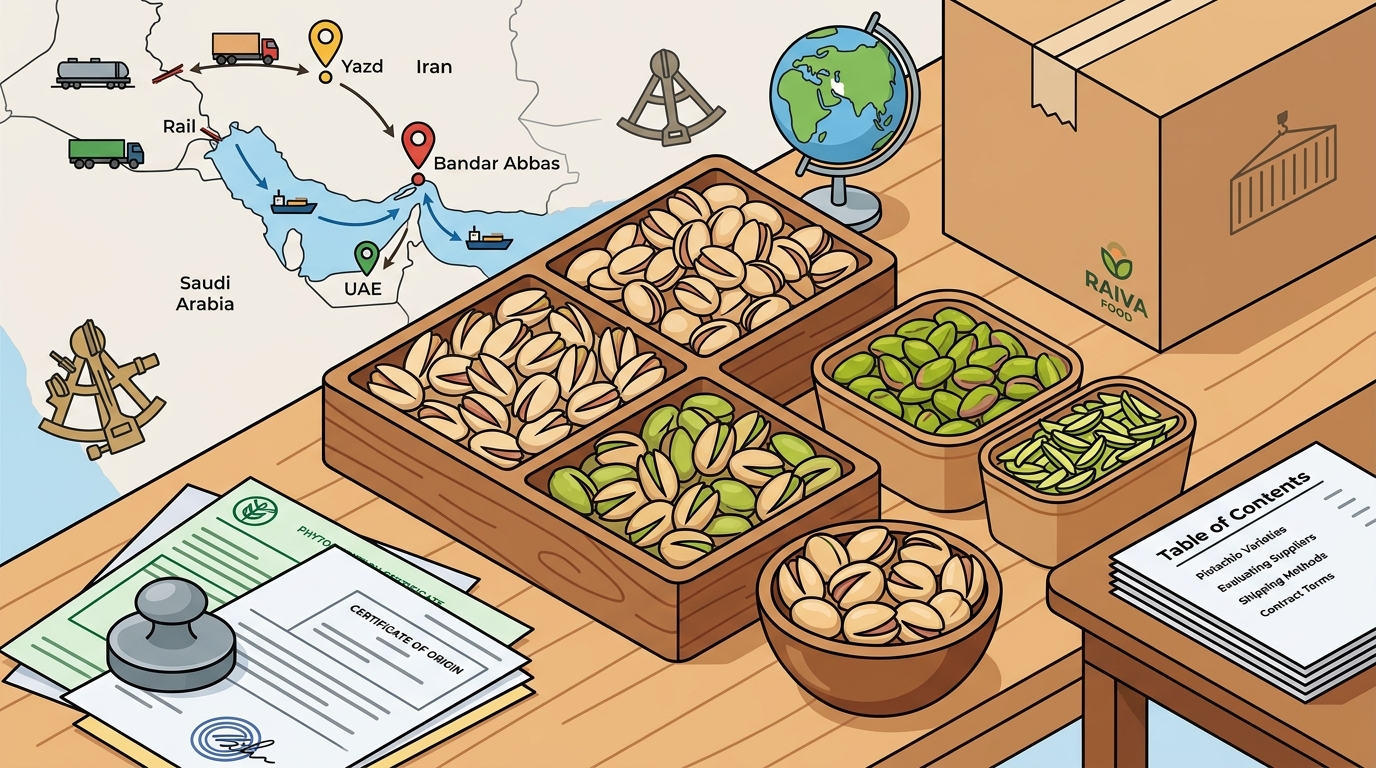
Logistics capability is a critical differentiator. Suppliers must offer multiple shipping routes to accommodate different destination ports. Raiva Food ships by sea from Bandar Abbas and overland through Iran's land borders. This dual capability allows buyers in the UAE and Saudi Arabia to choose the most efficient route based on their specific location and urgency.
What to Ask Before Committing
Before signing a contract, buyers must ask specific questions to ensure the supplier can meet their exact requirements. Vague answers are a red flag. You need concrete data on product identity, packaging, and documentation.
Product Identity and Specification
Ask for the botanical name and HS code. In-shell pistachios fall under HS code 0802.51, while shelled kernels fall under 0802.52. Confirm the specific cultivars available. Raiva Food supplies Akbari, Ahmad Aghaei, Kalleh Ghouchi, and Fandoghi cultivars. Each has distinct flavor and size profiles. Ask for the exact size range (e.g., 20/22, 22/24) and the expected split percentage for in-shell nuts.
Packaging and Minimum Order Quantity
Clarify the packaging format. In-shell pistachios are often packed in 50 kg jute sacks, while kernels are typically in 10 kg vacuum cartons. Confirm the minimum order quantity (MOQ). For many Iranian exporters, the MOQ for pistachios is 5 metric tons. This usually translates to a full 20ft container load. Ask if mixed loads are possible if you are also buying other dried fruits or dates.
How to Verify Credentials
Verification is the most critical step in B2B food trade. You must confirm that the supplier actually holds the certifications they claim and that their quality claims are backed by data.
Certifications and Documents
Request current certification documents. While ISO 9001 is a common standard, many exporters are still in the process of obtaining it. Raiva Food is currently working toward ISO 9001 certification to formalize its Quality Management System. More importantly, request the Certificate of Analysis (CoA) for the specific lot you are buying. This document proves the moisture, foreign matter, and size specifications for that exact batch. Do not accept a generic CoA from a previous year.
Physical Inspection
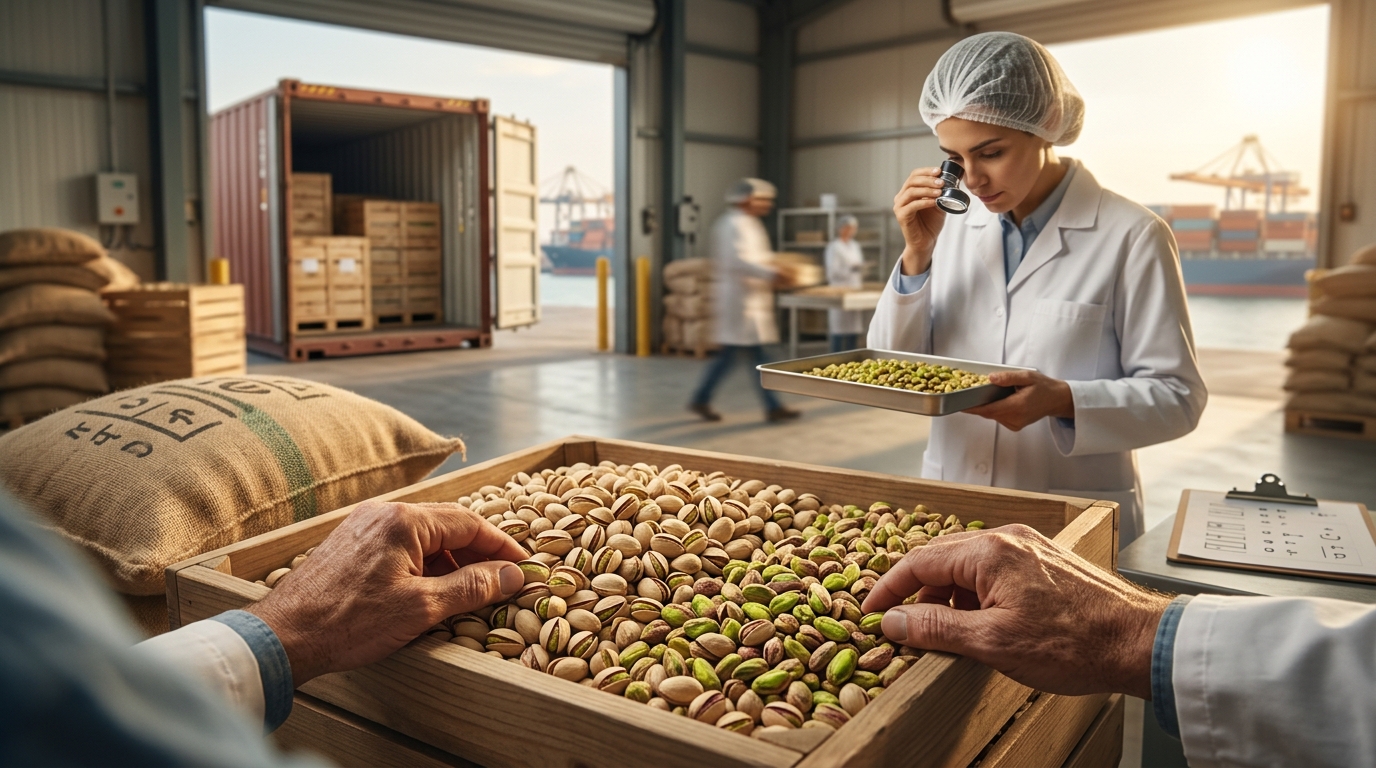
Pre-shipment inspection is a standard protection for buyers. You can nominate a third-party inspection agency to check the goods before they are loaded. This ensures the product matches the agreed specification. Raiva Food supports pre-shipment inspection at the buyer's cost. This step prevents disputes over quality upon arrival in the UAE or Saudi Arabia.
How the Process Works
The export process follows a structured sequence to ensure clarity and accountability. Understanding this workflow helps buyers manage expectations and timelines.
Quotation and Proforma Invoice
The process begins with a request for quotation (RFQ). You provide the product, volume, and destination. The exporter replies with a quotation and a proforma invoice. The proforma invoice is a critical document. It restates the agreed grade, specification, and price in writing. It serves as the basis for the final commercial invoice and the bank documents.
Shipping and Documentation
Once the proforma is accepted, the goods are prepared for shipment. Export documentation is prepared per shipment. This includes the Bill of Lading, Commercial Invoice, Packing List, and Certificate of Origin. For food products, a Phytosanitary Certificate and Health Certificate are often required by the destination country's customs authorities. Raiva Food issues these documents as part of the standard export process.
What Drives the Cost
Pricing for Iranian pistachios is dynamic and depends on several factors. There is no fixed list price; every quote is specific to the transaction.
Grade and Size
The grade and size of the pistachio are the primary price drivers. Larger sizes (lower ounce counts, e.g., 20/22) command a higher price per kilogram than smaller sizes (higher ounce counts, e.g., 28/30). Grade 1 pistachios, with higher split percentages and better color, are more expensive than Grade 2 or 3. Kernels are priced based on color uniformity and completeness (whole vs. slivers).
Route and Incoterms
The shipping route and Incoterms 2020 terms significantly impact the final cost. Shipping by sea from Bandar Abbas to Jebel Ali (UAE) or Dammam (Saudi Arabia) has different freight rates than overland trucking. The Incoterm (e.g., FOB, CIF, DDP) determines who pays for freight and insurance. Raiva Food quotes prices based on the specific route and transport mode. Always confirm the Incoterm in the proforma invoice.
Common Mistakes to Avoid
Buyers often make errors that lead to disputes or financial loss. Avoiding these mistakes is essential for a successful partnership.
Ignoring the Proforma Invoice
Many buyers focus only on the price and ignore the specification details on the proforma invoice. If the grade, size, or moisture content is not explicitly stated in writing, you have no legal recourse if the goods arrive substandard. Always ensure the proforma invoice matches your requirements exactly.
Skipping Inspection
Skipping pre-shipment inspection is a major risk. If you do not inspect the goods before they ship, you are accepting them as-is. Any quality issues discovered upon arrival are difficult to resolve. Always use a third-party inspector to verify the lot before loading.
Versus Alternative Origins
Iran is one of the world's largest producers of pistachios, but it is not the only option. Understanding the differences between origins helps buyers make informed decisions.
| Primary Cultivars | Akbari, Ahmad Aghaei, Kalleh Ghouchi | Sierra, Fresno, Nonpareil | Marcona, Ferradals |
| Typical Size Range | 20/22 to 28/30 | 20/22 to 26/28 | 22/24 to 26/28 |
| Flavor Profile | Rich, slightly sweet, earthy | Mild, buttery | Intense, nutty |
| Shipping to Gulf | Short sea/overland route | Long sea route | Medium sea route |
Iranian pistachios are often preferred in the Middle East for their rich flavor and competitive pricing. The shorter shipping distance to the UAE and Saudi Arabia also reduces transit time and potential quality degradation compared to shipments from the US or Europe.
For Specific Buyer Situations
Different buyers have different needs. A snack packer has different requirements than a bakery manufacturer.
Snack Packers
Snack packers typically buy in-shell pistachios. They require consistent size and high split percentages for consumer appeal. They often buy in large volumes (multiple containers) to secure a stable supply. Raiva Food supplies in-shell pistachios in 50 kg jute sacks, suitable for bulk handling.
Bakery and Confectionery
Bakery and confectionery manufacturers usually buy pistachio kernels. They require high color uniformity and low moisture content to ensure proper processing. Kernels are often bought in 10 kg vacuum cartons to maintain freshness. Raiva Food supplies whole kernels and slivers, sorted for color uniformity.
Rules and Protections
International trade is governed by specific rules and protections. Understanding these helps buyers navigate disputes and ensure compliance.
Contractual Protections
The sales contract and proforma invoice are your primary legal protections. They define the product, price, delivery terms, and dispute resolution mechanism. Ensure the contract specifies the governing law and the jurisdiction for any disputes. For B2B trade, arbitration is often preferred over litigation.
Quality Disputes
If the goods do not match the specification, you have the right to reject them or claim compensation. This is why the Certificate of Analysis and pre-shipment inspection are so important. They provide objective evidence of the product's condition at the time of shipment. Without this evidence, it is difficult to prove that the quality issue existed before shipping.
Local Specifics for UAE and KSA
The UAE and Saudi Arabia have specific import regulations and market preferences. Buyers in these countries should be aware of local requirements.
Import Regulations
Both the UAE and Saudi Arabia require a Phytosanitary Certificate and a Health Certificate for food imports. The Certificate of Origin is also required for customs clearance. Raiva Food issues these documents as part of the standard export process. Buyers should confirm with their local customs broker which specific documents are required for their destination port.
Market Preferences
In the UAE, there is a strong demand for premium, large-size in-shell pistachios for retail and hospitality. In Saudi Arabia, there is a high demand for pistachio kernels for traditional sweets and confectionery. Buyers should align their purchasing strategy with local market trends.
Timing and Seasonality
Pistachios are a seasonal crop. Timing your purchase can impact both price and availability.
Harvest and Storage
The pistachio harvest in Iran typically occurs in September and October. After harvest, the nuts are hulled, dried, and graded. They are then stored in cold storage. This means that while fresh harvest is available in late autumn, year-round supply is possible from stock. Raiva Food supplies pistachios from stock rather than to a strict harvest window. This allows buyers to purchase at any time of the year, though prices may fluctuate based on supply and demand.
Results Over Time
Building a long-term relationship with a reliable exporter yields significant benefits. Consistency in quality and supply is the primary goal.
Supply Chain Stability
By working with a single, verified exporter, buyers can achieve supply chain stability. This reduces the risk of quality variation and supply disruptions. Raiva Food has been exporting since 2010, providing a track record of reliability. Long-term contracts can help secure pricing and volume commitments.
Key Takeaways
- Verify the supplier's credentials and request a Certificate of Analysis for the specific lot.
- Ensure the proforma invoice restates the agreed grade, size, and moisture content in writing.
- Use pre-shipment inspection to verify quality before the goods are loaded.
- Understand the difference between in-shell (HS 0802.51) and kernel (HS 0802.52) pistachios.
- Consider the shipping route (sea vs. overland) and Incoterms when evaluating cost.
- Align your purchasing strategy with local market preferences in the UAE and Saudi Arabia.
- Build a long-term relationship with a verified exporter for supply chain stability.
Frequently Asked Questions
What is the minimum order quantity for Iranian pistachios?
The minimum order quantity for pistachios is typically 5 metric tons, which usually translates to a full 20ft container load. This applies to both in-shell and kernel pistachios.
What is the difference between in-shell and kernel pistachios?
In-shell pistachios are sold with the hard outer shell intact. They are graded by size and split percentage. Kernel pistachios are shelled and sold as the edible nut. They are graded by color and completeness (whole vs. slivers).
How long does it take to ship pistachios from Iran to the UAE?
Shipping time depends on the route. Sea freight from Bandar Abbas to Jebel Ali typically takes 3 to 5 days. Overland trucking through land borders may take 2 to 4 days. Exact transit times should be confirmed with the exporter and freight forwarder.
What documents are required for importing pistachios into Saudi Arabia?
Importers typically require a Bill of Lading, Commercial Invoice, Packing List, Certificate of Origin, Phytosanitary Certificate, and Health Certificate. Specific requirements may vary, so buyers should confirm with their local customs broker.
Can I get a sample before placing a large order?
Yes, samples can be couriered on request before you commit to a container. This allows you to evaluate the quality and flavor profile before making a large purchase.
What are the main cultivars of Iranian pistachios?
The main cultivars are Akbari, Ahmad Aghaei, Kalleh Ghouchi, and Fandoghi. Each has distinct characteristics in terms of size, color, and flavor.
Ready to Source Iranian Pistachios?
If you are looking for a reliable supplier of in-shell pistachios and pistachio kernels for the UAE or Saudi Arabia, Raiva Food is your partner. We have been exporting since 2010 and offer verified quality, transparent documentation, and flexible logistics. To discuss your requirements, request a quote from our export desk.